


Most organizations spend heavily on total rewards. Pay, benefits, perks, recognition, and the technology that ties them together add up fast. Yet ask employees how those rewards feel, and you’ll often get a shrug.
We dug into this gap in a recent webinar with Deloitte. The core question: why do rewards programs cost so much, take so much effort to run, and still land with so little impact?
Deloitte’s research offers a clear answer. And one of its biggest findings is about something many companies still treat as a nice-to-have: employee recognition.
From “Meh” to Mature: How the Picture Changed
Back in 2018, Deloitte’s High-Impact Rewards study found that organizations were delivering real value through rewards, but employees weren’t feeling it. Programs existed on paper. They rarely connected to performance, culture, or business strategy, and they rarely felt like one experience.
Deloitte’s updated research tells a different story. The best-performing companies didn’t win by adding better perks. They won by changing how they run rewards: as one connected system instead of a pile of separate initiatives.
Deloitte calls this shift Total Rewards maturity. (Read the full Deloitte report here.)
Here’s the finding HR and people leaders should pay closest attention to.
In 2018, recognition wasn’t a meaningful factor in rewards maturity. In the latest research, it’s one of the clearest dividing lines between high-maturity organizations and everyone else.
What separates the leaders isn’t whether they recognize people. It’s how:
In other words, recognition stopped being a program and became part of how work gets done.
Rewards maturity isn’t about being more generous. It’s about being more disciplined. According to Deloitte, high-maturity organizations are:
Deloitte tested rewards practices against business results and validated the link. That changes the conversation with the C-suite. Total rewards, and recognition with it, becomes a performance lever, not a line-item cost.
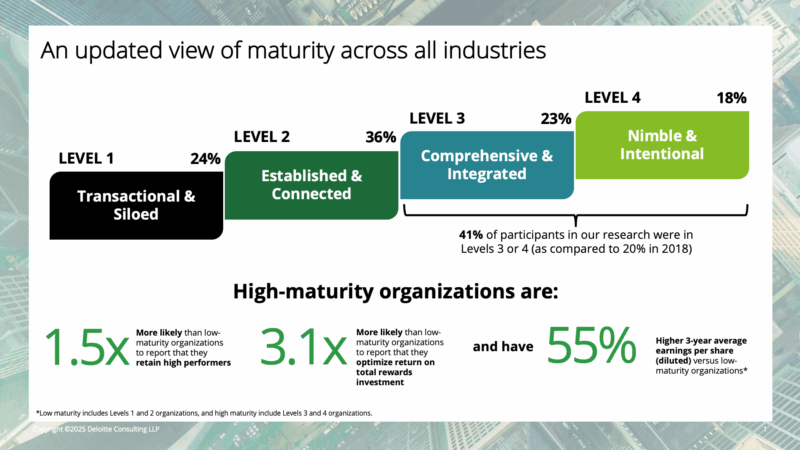
Deloitte’s model describes four stages. Here’s what each one tends to look like for recognition specifically:
Maturity level | What rewards look like | What recognition looks like |
|---|---|---|
1. Transactional and Siloed | Compliance-driven, fragmented, little data | Sporadic, inconsistent, mostly tenure-based |
2. Established and Connected | Basic alignment, standardized communication | A program exists, but no unifying strategy behind it |
3. Comprehensive and Integrated | Strategy tied to business goals, centralized platforms, data-informed | Recognition shapes a broad set of programs and is visible across teams |
4. Nimble and Intentional | Fully integrated system, personalized, analytics-led | Recognition is part of the culture, not a program people log into |
Deloitte notes the hardest jump is from Level 1 to Level 2. Many companies spend plenty but never cross the line where rewards stop being administered and start being designed.
Why the Pandemic Accelerated the Shift
Deloitte research lead Michael Gilmartin points to the pandemic as the turning point. Organizations had to face a blunt question: how are we really showing up for our people right now?
Three things changed as a result:
One of the most useful myths Deloitte’s research breaks: maturity doesn’t come from stacking up more programs.
High-maturity organizations don’t chase trends. They invest where it matters most for their people and their business model. They listen to employees continuously, act on what they hear, and adjust.
That’s also why there’s no universal checklist. A company can be advanced in recognition and still early in analytics. What matters is alignment and intent.
If recognition is now a marker of rewards maturity, here’s where to start:
For executives, the takeaway is simple. Rewards maturity is about organizational coherence.
When the CEO, CFO, and CHRO are aligned, rewards reinforce strategy, build trust and fairness, strengthen resilience, drive retention, and support long-term financial performance. When they aren’t, rewards stay expensive, misunderstood, and underused.
The most mature organizations Deloitte studied stopped asking, “What rewards should we offer?” They started asking, “What experience are we designing for our people, and how does it help us win?”
That experience has to work for everyone, from global teams and remote workers to shift-based staff and very different departments. It needs to feel consistent and personal at the same time.
Recognition is what holds it together. It connects people to purpose, validates their contribution, and makes great work visible across the organization.
Recognition isn’t a perk. It isn’t a program. It’s a business system.
What is total rewards maturity? It’s Deloitte’s term for how intentionally an organization designs and runs its total rewards, from fragmented and compliance-driven (Level 1) to fully integrated, personalized, and data-led (Level 4).
How does employee recognition affect total rewards maturity? Deloitte’s latest research found that the visibility, frequency, and authenticity of recognition clearly separate high-maturity organizations from the rest. In 2018, recognition wasn’t a defining factor.
What results do high-maturity organizations see? Deloitte found they’re 3.1x more likely to optimize rewards ROI, 1.5x more likely to retain high performers, and deliver 55% higher three-year average EPS than low-maturity peers.
Where should an organization start? With an honest audit of current recognition and rewards, then aligning recognition to company values and goals, opening it to peers, and measuring the results.
Ready to make recognition part of how your organization works? WorkProud helps companies build recognition and rewards programs that reach every employee and tie back to business results. Book a demo or talk with our team.
Want the full breakdown of Deloitte’s maturity model? Read What Deloitte’s 2025 Research Reveals About the Future of Total Rewards on the Online Rewards blog.
An icon of style from Hollywood to hip-hop, the Wayfarer never stands still. Forever embraced by the next generation of culture makers, now its journey continues with AI-enhanced wearable tech. Ray-Ban Meta Wayfarer enables you to live in the moment and share how you see the world. Listen, call, capture and livestream features are seamlessly integrated within the classic frame. Eye size: 50; Frame: Matte Black; Lens: Clear/Graphite Green Transitions; Lens Material: Standard Plastic
Color: Matte Black/Clear-Graphite Green Transitions
A
Afghanistan
Albania
Algeria
Andorra
Angola
Antigua & Deps
Argentina
Armenia
Australia
Austria
Azerbaijan
B
Bahamas
Bahrain
Bangladesh
Barbados
Belarus
Belgium
Belize
Benin
Bhutan
Bolivia
Bosnia Herzegovina
Botswana
Brazil
Brunei
Bulgaria
Burkina
Burundi
C
Cambodia
Cameroon
Canada
Cape Verde
Central African Rep
Chad
Chile
China
Colombia
Comoros
Congo
Congo {Democratic Rep}
Costa Rica
Croatia
Cuba
Cyprus
Czech Republic
Denmark
D
Djibouti
Dominica
Dominican Republic
E
East Timor
Ecuador
Egypt
El Salvador
Equatorial Guinea
Eritrea
Estonia
Ethiopia
F
Fiji
Finland
France
G
Gabon
Gambia
Georgia
Germany
Ghana
Greece
Grenada
Guatemala
Guinea
Guinea-Bissau
Guyana
H
Haiti
Honduras
Hungary
I
Iceland
India
Indonesia
Iran
Iraq
Ireland {Republic}
Israel
Italy
Ivory Coast
J
Jamaica
Japan
Jordan
K
Kazakhstan
Kenya
Kiribati
Korea North
Korea South
Kosovo
Kuwait
Kyrgyzstan
L
Laos
Latvia
Lebanon
Lesotho
Liberia
Libya
Liechtenstein
Lithuania
Luxembourg
M
Macedonia
Madagascar
Malawi
Malaysia
Maldives
Mali
Malta
Marshall Islands
Mauritania
Mauritius
Mexico
Micronesia
Moldova
Monaco
Mongolia
Montenegro
Morocco
Mozambique
Myanmar
M
Namibia
Nauru
Nepal
Netherlands
New Zealand
Nicaragua
Niger
Nigeria
Norway
O
Oman
P
Pakistan
Palau
Panama
Papua New Guinea
Paraguay
Peru
Philippines
Poland
Portugal
Q
Qatar
R
Romania
Russian Federation
Rwanda
S
St Kitts & Nevis
St Lucia
Saint Vincent & the Grenadines
Samoa
San Marino
Sao Tome & Principe
Saudi Arabia
Senegal
Serbia
Seychelles
Sierra Leone
Singapore
Slovakia
Slovenia
Solomon Islands
Somalia
South Africa
South Sudan
Spain
Sri Lanka
Sudan
Suriname
Swaziland
Sweden
Switzerland
Syria
T
Taiwan
Tajikistan
Tanzania
Thailand
Togo
Tonga
Trinidad & Tobago
Tunisia
Turkey
Turkmenistan
Tuvalu
U
Uganda
Ukraine
United Arab Emirates
United Kingdom
Uruguay
Uzbekistan
V
Vanuatu
Vatican City
Venezuela
Vietnam
Y
Yemen
Z
Zambia
Zimbabwe
Here you will find insights curated for leadership seeking in-depth industry knowledge. Explore comprehensive studies, helpful guides, and expert white papers.
*By selecting “VIEW RESOURCES,” you agree to WorkProud’s Privacy Policy. You may unsubscribe from our emails at any time. Please note when unsubscribing: it may take up to 10 business days for your request to take effect.