


Your employees already told you what they want. They want to recognize each other, not wait for a manager to do it on their behalf. And you agree with them. Top-down recognition built structure into your program, but it also built a bottleneck that leaves most of your workforce invisible.
Organizations where recognition flows only through managers see declining engagement among the populations that never receive it. Gallup reports in the State of the Global Workplace that 77% to 80% of the global workforce is “not engaged” or “actively disengaged.” The people going to president’s club get celebrated. The person who onboarded three new hires while covering a teammate’s parental leave? Nobody saw that.
You’re not here because peer to peer employee recognition is a new concept. You’re here because you’ve tried to make it work or you’re about to and the operational questions are piling up: How do you keep it from becoming a popularity contest? How do you make sure participation doesn’t die after the first month? And how do you prove to leadership that any of this is producing results?
Those are the right questions. And they’re the ones most content about peer recognition skips entirely.
Top-down recognition wasn’t arbitrary. It created accountability. When a manager recognized an employee, that recognition carried career weight it showed up in performance reviews, informed promotion decisions, and connected to documented goals. For organizations with formal structures and clear reporting lines, it worked.
One HR leader described her current model: “We have another vendor for our e-cards, milestone, and above and beyond nomination awards… and then we have an ET-driven exceptional performance award with an internal nomination tool.” That’s not dysfunction that’s a recognition program built for a specific operating model.
Manager recognition still matters. But manager recognition alone can’t do what your employees are asking for.
Three ceilings show up when organizations try to build peer culture on a manager-only foundation:
Structural exclusion. “In traditional recognition, only really high top performers are actually getting rewards. You think about the people going to president’s club. You think about the top sellers.” When recognition requires a manager to initiate it, frequency drops and distribution narrows. The middle 70% of your workforce, the people holding operations together, rarely sees their name come up.
Operational friction. “What do you have to do at a basic company? You have to go open a PO. You have to go work with the office ops. You have to go through this whole process to try to reward your team even as a leader.” When every recognition moment requires an approval chain, the recognition doesn’t happen. Not because leaders don’t want to recognize it because the system makes it too expensive in time.
Invisible populations. “They feel separate from the rest of the organization. They are the hidden warriors.” Frontline workers, field teams, cross-functional contributors who don’t report to the manager running the recognition program exist outside the line of sight. Manager-only recognition structurally excludes anyone the manager doesn’t directly observe.
None of these ceilings mean the manager model failed. They mean your organization outgrew it. Your employees told you as much when they asked for peer-to-peer.
Most peer recognition programs start with good intentions and a Slack channel. A few months later, participation has dropped, the messages feel performative, and you’re back to relying on managers because at least that model had structure.
Your people want to recognize each other. They just don’t have the infrastructure to do it at scale.
Here’s what changes when peer recognition runs on purpose-built infrastructure instead of initiative.
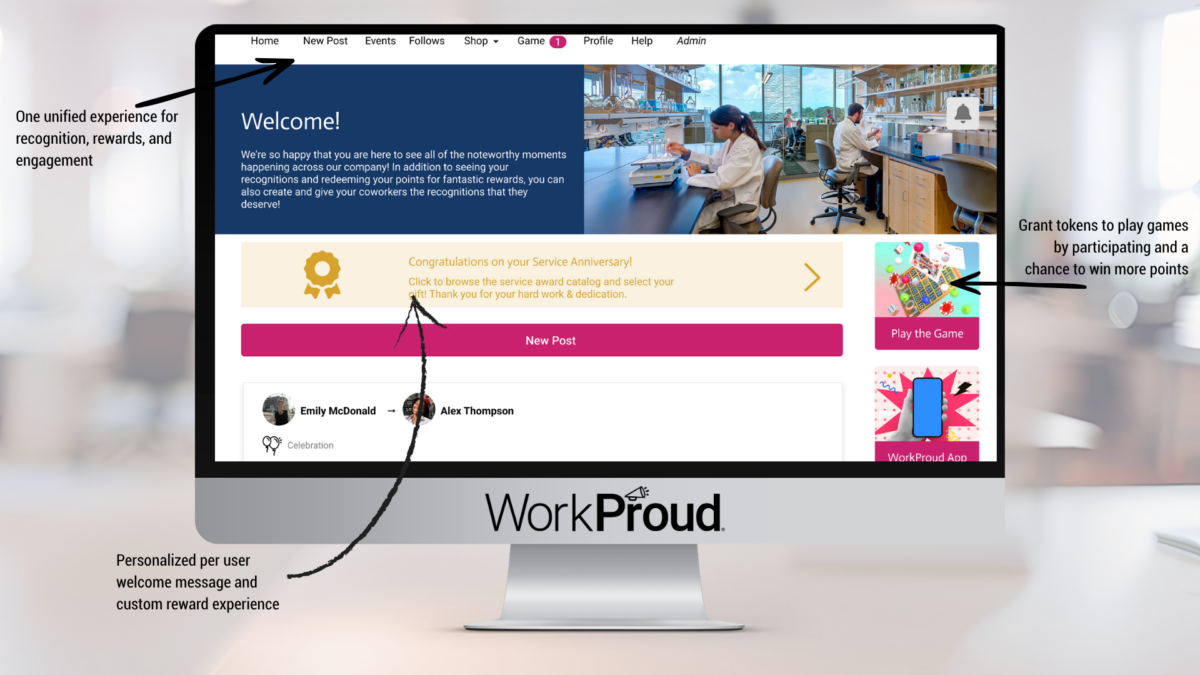
The core shift is removing the manager gate entirely. Any employee recognizes any other employee in real time, tied to a company value, with points attached. No approval form. No PO. No waiting for the next team meeting.
Here’s the workflow: an employee sees a colleague step up on a cross-functional project. She opens the app, selects her colleague, writes a recognition tied to the “Collaboration” value, attaches 10 points, and posts it. The recognition appears on a social feed visible across the entire organization. Colleagues in three different time zones see it that afternoon and add comments. The colleague’s manager gets notified. The data is searchable when the performance review season arrives.
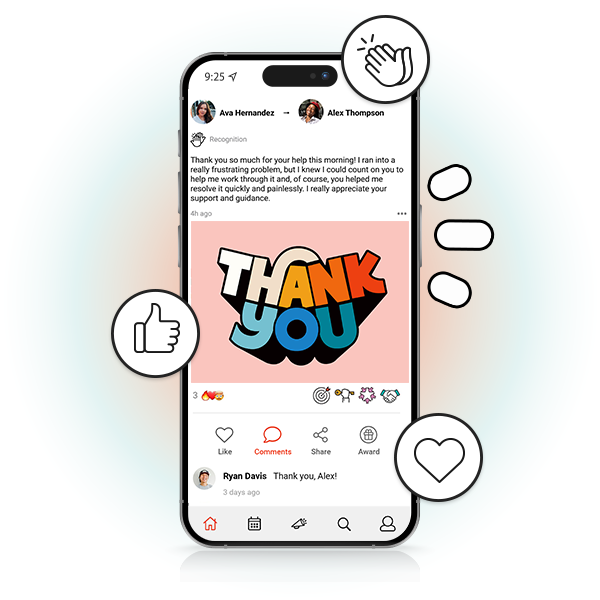
That social feed is what separates platform-driven peer recognition from Slack-channel peer recognition. In Slack, a recognition post scrolls past in minutes. On a social feed built for recognition, it persists. It’s visible to leadership. It creates what one organization called “the virtual break room” a place where distributed colleagues interact around shared work, not just shared chat channels.
One organization that made this shift from manager-only to peer-to-peer on a recognition platform went from 140 recognition moments per year to over 11,000. Their participation rate hit 87% across the organization.
“That has been to me the big game changer — it puts not just the recognition, but the reward in the hands of the employees.”
Those numbers held. The shift from 140 to 11,000 was structurally a change in how recognition operates day to day, not a launch spike that faded.
This is the question every program owner asks first: “If I let everyone recognize everyone, how do I keep this from becoming a popularity contest?”
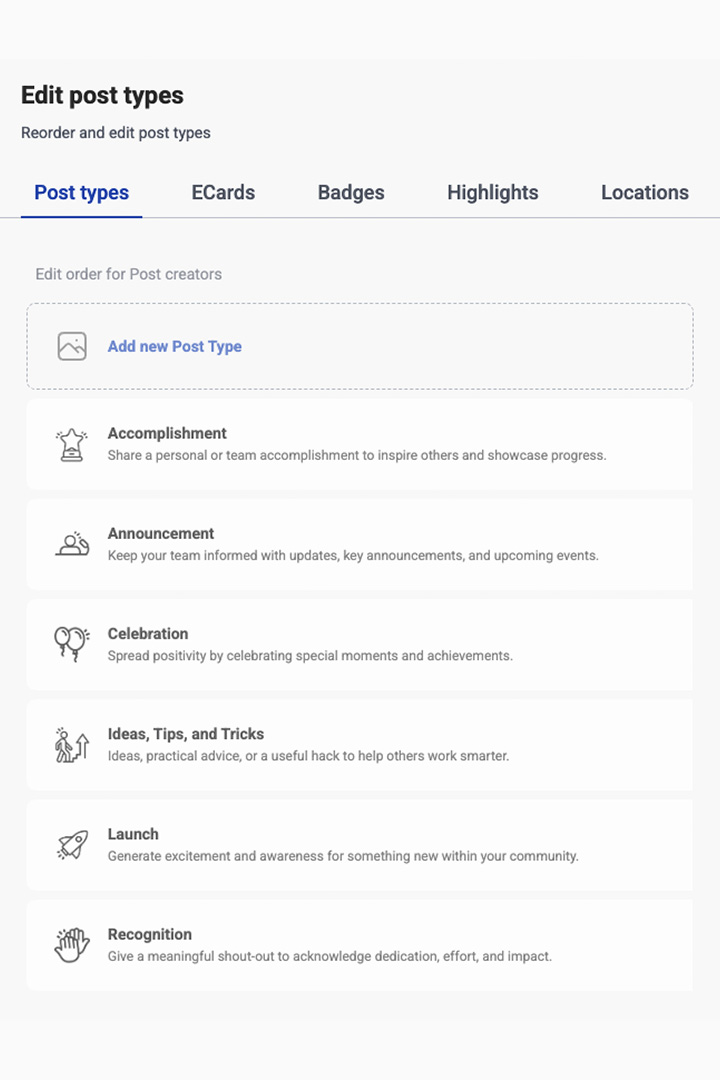
You solve it with structure, not memos about being nicer to each other. When every recognition requires selecting a company value, Collaboration, Innovation, Ownership, Customer Focus — the recognition becomes purposeful. Instead of “great job!” the recognition reads: “I’m recognizing you for Collaboration because you pulled three teams together to hit the migration deadline.”
“Tie it back to a leadership competency. That is very important — to be able to tie to our behaviors that we want to drive.”
Values-based tagging does two things the popularity-contest concern doesn’t account for. First, it forces specificity. The person giving the recognition has to articulate what they’re recognizing and why it maps to a company value. Second, it generates trend data. Over time, you can see which values are being lived and which are nominal. If “Innovation” is flat while “Teamwork” is surging, you have a signal, and you can launch a targeted recognition campaign for innovation-related behaviors.
WalkMe saw this play out directly. Their “Work as One WalkMe” value score increased from 43 to 87, a 102% increase after implementing values-based peer recognition. “Take ownership is at 94. It was kind of stagnant before. What changed? We’re recognizing it. We’re rewarding it.”
The recognition system becomes a values measurement engine producing hard data about which behaviors employees are actually demonstrating, quarter over quarter.
The second question program owners ask: “What if everyone’s excited for the first month and then it dies?”
Fair concern. Most peer recognition programs do fade because they rely on goodwill instead of reinforcement loops.
The programs that sustain participation solve for reinforcement, not reminders. Token earning for recognition activities, customizable badges tied to values or behaviors, leaderboard visibility across teams these create a loop where giving recognition becomes as visible and rewarded as receiving it. When an employee recognizes 10 colleagues in a month and earns a “Culture Champion” badge visible on their profile, the leaderboard shows who’s building culture, not just who’s being celebrated.
WalkMe’s 87% participation rate wasn’t a launch metric. It lasted over four years. Their HR leader stopped having to push adoption entirely:
“It’s not me knocking on doors. They’re now knocking on my door saying, how do we get in here?”
Other departments saw what peer recognition was doing for the teams already on the platform and asked to be included.
That’s the difference between a recognition initiative and recognition infrastructure. Initiatives require constant energy to maintain. Infrastructure generates its own momentum.
The third question and the one that matters most in your next QBR: “How do I prove this is working?”
Before implementing a recognition platform, most program owners operate on instinct.
“Before WorkProud I couldn’t prove it. I had no data. I just had vibes and email sends and things. That’s not helpful.”
A recognition analytics dashboard changes the conversation. Recognition data filtered by department, location, or manager shows which teams have high peer recognition activity and which have gaps. Cross-reference peer recognition frequency with engagement survey data and attrition trends, and you have a story that leadership can act on.
Here’s what that looks like operationally: you pull up the dashboard, filter by department, and see that Engineering has low peer recognition activity. You cross-reference with their recent attrition spike. You present this to the VP of HR with a clear recommendation targeted recognition intervention for Engineering. Next quarter, you show the intervention’s impact.
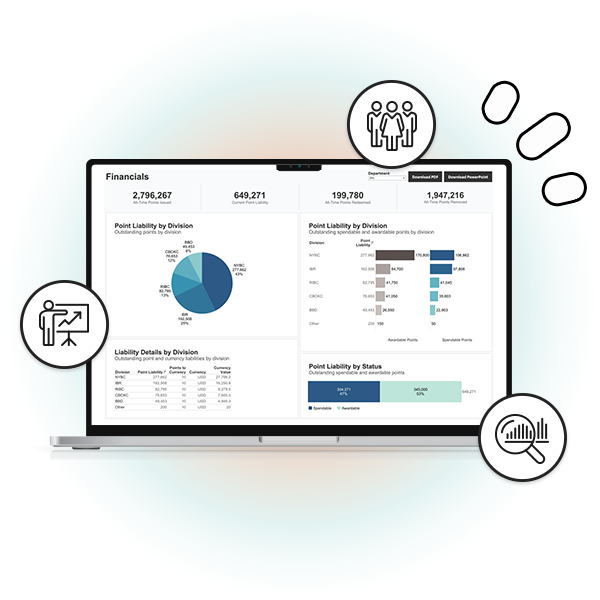
That’s how you move from “we launched peer recognition” to “here’s what it’s doing for retention.”
“How do you truly understand who are your culture builders versus your culture stabilizers versus your culture distractors? It’s really clear when you’re in a system like WorkProud.”
WalkMe’s engagement scores increased 130% over four years on the platform — while their recognition budget declined year over year. Their HR leader spends 10-15% of her time on recognition and rewards. The infrastructure runs the program; she runs the strategy.
You can launch peer recognition without a platform. Plenty of organizations do a Slack channel, a shared spreadsheet, a recurring all-hands shoutout.
Those programs hit a ceiling around month three. Participation drops because there’s no reinforcement loop. Recognition can’t be tied to values because there’s no structured tagging. Leadership can’t see patterns because there’s no data layer. And the program owner spends more time maintaining the program than improving it.
The organizations that sustain peer recognition at scale 87% participation over four years, 11,000+ recognition moments annually, engagement scores rising while budgets decline aren’t running better Slack channels. They’re running recognition on infrastructure designed for exactly this job.
When the business case needs building, the data is already there — recognition frequency by team, values adoption trends, retention correlation. The organizations running peer recognition on infrastructure don’t have to argue it’s working. The dashboard shows it.
If you’re building a broader recognition program from scratch, the peer-to-peer component is one piece of a larger architecture.
Evaluating platforms? Look for values-based recognition, social feed visibility, mobile-first access, and analytics that connect recognition to retention.
See how a peer recognition program operates when it’s built on infrastructure, not initiative.

WorkProud is committed to helping its clients create a unified approach to the employee experience by helping them build cultures of workplace pride. Trusted by millions of users at some of the world’s most recognized employer brands, WorkProud delivers a comprehensive approach to building company cultures that inspire people to be Proud of their Work and Proud of their Company.
An icon of style from Hollywood to hip-hop, the Wayfarer never stands still. Forever embraced by the next generation of culture makers, now its journey continues with AI-enhanced wearable tech. Ray-Ban Meta Wayfarer enables you to live in the moment and share how you see the world. Listen, call, capture and livestream features are seamlessly integrated within the classic frame. Eye size: 50; Frame: Matte Black; Lens: Clear/Graphite Green Transitions; Lens Material: Standard Plastic
Color: Matte Black/Clear-Graphite Green Transitions
A
Afghanistan
Albania
Algeria
Andorra
Angola
Antigua & Deps
Argentina
Armenia
Australia
Austria
Azerbaijan
B
Bahamas
Bahrain
Bangladesh
Barbados
Belarus
Belgium
Belize
Benin
Bhutan
Bolivia
Bosnia Herzegovina
Botswana
Brazil
Brunei
Bulgaria
Burkina
Burundi
C
Cambodia
Cameroon
Canada
Cape Verde
Central African Rep
Chad
Chile
China
Colombia
Comoros
Congo
Congo {Democratic Rep}
Costa Rica
Croatia
Cuba
Cyprus
Czech Republic
Denmark
D
Djibouti
Dominica
Dominican Republic
E
East Timor
Ecuador
Egypt
El Salvador
Equatorial Guinea
Eritrea
Estonia
Ethiopia
F
Fiji
Finland
France
G
Gabon
Gambia
Georgia
Germany
Ghana
Greece
Grenada
Guatemala
Guinea
Guinea-Bissau
Guyana
H
Haiti
Honduras
Hungary
I
Iceland
India
Indonesia
Iran
Iraq
Ireland {Republic}
Israel
Italy
Ivory Coast
J
Jamaica
Japan
Jordan
K
Kazakhstan
Kenya
Kiribati
Korea North
Korea South
Kosovo
Kuwait
Kyrgyzstan
L
Laos
Latvia
Lebanon
Lesotho
Liberia
Libya
Liechtenstein
Lithuania
Luxembourg
M
Macedonia
Madagascar
Malawi
Malaysia
Maldives
Mali
Malta
Marshall Islands
Mauritania
Mauritius
Mexico
Micronesia
Moldova
Monaco
Mongolia
Montenegro
Morocco
Mozambique
Myanmar
M
Namibia
Nauru
Nepal
Netherlands
New Zealand
Nicaragua
Niger
Nigeria
Norway
O
Oman
P
Pakistan
Palau
Panama
Papua New Guinea
Paraguay
Peru
Philippines
Poland
Portugal
Q
Qatar
R
Romania
Russian Federation
Rwanda
S
St Kitts & Nevis
St Lucia
Saint Vincent & the Grenadines
Samoa
San Marino
Sao Tome & Principe
Saudi Arabia
Senegal
Serbia
Seychelles
Sierra Leone
Singapore
Slovakia
Slovenia
Solomon Islands
Somalia
South Africa
South Sudan
Spain
Sri Lanka
Sudan
Suriname
Swaziland
Sweden
Switzerland
Syria
T
Taiwan
Tajikistan
Tanzania
Thailand
Togo
Tonga
Trinidad & Tobago
Tunisia
Turkey
Turkmenistan
Tuvalu
U
Uganda
Ukraine
United Arab Emirates
United Kingdom
Uruguay
Uzbekistan
V
Vanuatu
Vatican City
Venezuela
Vietnam
Y
Yemen
Z
Zambia
Zimbabwe
Here you will find insights curated for leadership seeking in-depth industry knowledge. Explore comprehensive studies, helpful guides, and expert white papers.
*By selecting “VIEW RESOURCES,” you agree to WorkProud’s Privacy Policy. You may unsubscribe from our emails at any time. Please note when unsubscribing: it may take up to 10 business days for your request to take effect.