
So you’ve finally decided to fix recognition this quarter.
Naturally, you start looking at platforms and hit up the Google, ChatGPT, Claude, Alexa, Siri, and a slew of other tools to help narrow down the search from a kazillion to (hopefully) three to five.
Sadly though, you start to realize a trend.

For each and every platform that sounds interesting, the first and only thing you can do is book a demo.
Not try it. Not see it. Book a call, hold for a salesperson, sit through a slide deck, wait on pricing, then take it upstairs. You wanted to start recognizing your people.
You got a procurement project instead.
The space between the decision to act and the permission to begin is where recognition programs often stall. These initiatives don’t usually fail due to budget cuts, but because the effort required to start becomes overwhelming. I have witnessed countless instances where focus shifts to comparing features, causing the core purpose of the project to be lost under a mountain of technical widgets and integrations. None of these tools address the fundamental question facing leadership: are employees aligned with company values, and is there a measurable way to verify that alignment?
We built something different. Twenty-five years in recognition, rewards, and incentives. More than 450 customer programs. Over two million transactions a year. We packaged all of it into a turnkey version of WorkProud you can stand up today. Branded. Live.
Complimentary for up to 20 people. No sales call required.
Here is what that actually means, and why the alternative you are being sold is more complicated than it needs to be.
Not from bad intentions. The HR team builds them with care. Leadership signs the budget. Someone picks a platform, loads the employees, sends a launch email. Participation spikes in week one. Then it fades. Six months later the program runs at 20% utilization, nobody can explain what it is producing, and the CFO wants a meeting.
That is not a technology failure. It is a product failure. And it is one of the most preventable problems in people operations.
We have spent more than two decades watching organizations buy recognition programs that never reach their potential. Not because the people running them do not care. Because the programs were built to launch, not to last. The platform gets deployed, the admin gets a login, and the real work of building a recognition culture gets handed back to an HR team already juggling ten other priorities.
The numbers behind this crossed a threshold. Only 21% of employees are engaged at work globally, according to Gallup’s 2024 State of the Global Workplace Report. That disengagement costs U.S. companies roughly $438 billion a year in lost productivity. Deloitte’s 2025 High-Impact Total Rewards study found that 62% of executives say their rewards programs produce no measurable business impact, even as compensation and benefits consume 55 to 60% of operating expenses. The organizations at the top of Deloitte’s maturity model are 3.1x more likely to optimize total rewards ROI and deliver 55% higher three-year earnings per share than the ones at the bottom.
The question stopped being whether recognition drives business outcomes. It is whether your program is built to capture them, or built to be easy to sell.
Look at what is being marketed to small and mid-sized teams this year and a pattern shows up.
The newest entrants lead with a mission. Save the planet with every reward. Add a wellness tracker so people earn points for steps. Wrap a discount shopping mall around the rewards catalog. Layer AI on top to personalize what shows up. Every one of those sounds great in a launch announcement. Even as someone who appreciates effective marketing, I have fallen into the trap of believing flashy features could substitute for the fundamental principles of a successful initiative.
And to be clear, it is obviously a good thing to try to save the planet. I just don’t think it makes much sense to use that as a hook to settle for something you didn’t ask for. On the flip side, look at organizations like Loop & Tie. Their focus on sustainability makes sense and thinks about their buyer without any gimmicks.
But here’s the part that makes my skin crawl –especially for the folks in the back not looking to speak to a human and just need a blank canvas so they can go!
Almost all of the recognition platforms share one trait: Before you can see whether the thing works for your people, YOU HAVE TO TALK TO SALES.
Fill out the form.
Wait for the BDR to call back.
Wait for the AE’s availability.
Get a rough quote.
Wait for the VP of Sales to reach out to your boss behind your back to see if the “decision maker” wants to make a deal.
… and on and on and on it goes.
The product sits behind a gate, and the gate is a person whose job is to close you.
Only the only thing closing is the opportunity for you to do a damn thing.
So we removed all of that.
Seriously, stop reading and just go here: app.workproud.com and you’ll be up and running in minutes (possibly seconds if you type fast).
Turnkey is one of the most abused words in software. So here is what it means at WorkProud, step by literal step:
That’s it… you now have a recognition program ready for your team.
No manual account creation. No IT provisioning. Upload, process, done.
None of it requires code. It requires judgment about how you want your culture to work. That is the good kind of complexity, and it is the kind worth owning.
Day one looks like this: load the file, confirm branding, set up post types and core values. The program is live. People can log in.
After that, running it takes 15 to 30 minutes a week:
“I probably spend 15% of my time in the system, and it enables me to do everything else that I want to do.” – Madeline Des Jardins, Global Sr. Director of Internal Communications and Employee Engagement
Despite overseeing a global recognition ecosystem with a 96.2% adoption, 12,100 recognition posts, and 66,707 total logins, she spends only about 15% of her time inside WorkProud.
Most admins do as follows: They check the flagged content indicator. Glance at the notification feed. Update a post type if a campaign is running. The daily sweep is about five minutes. That is the whole job.
This is the proof that ‘no sales call’ is real, not a marketing line. The reason we can hand you the product instead of a demo is that the product was built for the person running it.
The complimentary version is not a stripped-down trial.
Your people get a social feed that works the way the apps on their phone already work. They recognize each other, react, comment, and build on each other’s posts in real time.
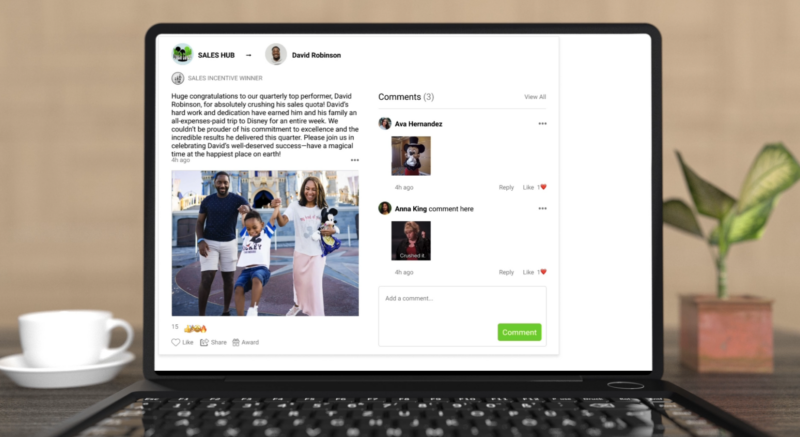
A ‘For You’ feed shows the teams and people they follow. An ‘All Posts’ view shows everything across the company, one tap away. Someone in a branch, on a floor, or working from home gets the same visibility as someone at headquarters. The platform does not know the difference, and that equity is the point.
It runs on the highest-rated mobile app in the category, 4.9 stars on Apple and 4.8 on Google. That matters more than it sounds. Push notifications are the single biggest driver of daily participation. A recognition lands on someone’s phone like a personal message, they tap it, they are in the post, they reply in seconds. Programs that get people onto mobile sustain engagement long past launch. The ones that live only on a desktop login fade.
Recognition no one can see has half the impact of recognition everyone can see. That is not philosophy. It is how behavioral reinforcement works.
If you want to turn rewards on, it takes one 10-minute call. Not a sales call (sorry bro). A security verification, because real money and a global catalog are involved and we take that seriously. Once you are verified, you get the full catalog: merchandise across hundreds of categories, gift cards to the brands people actually use, prepaid cards they can spend anywhere, travel and experiences, and even branded company items (does require customization fyi). More than two million rewards across 35-plus suppliers, fulfilled locally in 150-plus countries, in local currencies and languages, with the fulfillment handled by us.

Here is a quieter difference that matters. Some platforms build their economics on the reward markup, or on a discount-marketplace layer that turns your recognition program into one more place to upsell your employees. Ours is designed for recognition and appreciation, not compensation and not commerce. Because we aggregate purchasing across hundreds of active programs, we negotiate pricing most single organizations cannot get on their own, and we do not bury margin where procurement cannot find it. Every point goes further, and finance can explain exactly what you are paying for.
This is not theory. It is what the design does when real organizations run it.
Webster Bank, a 4,500-person commercial bank across 195 branches, saw a 265% increase in recognition activity in their first year on WorkProud, from 3,698 posts to 13,416. Overall engagement rose three points. The recognition-specific survey question rose five. “When you put recognition tools in the hands of managers, you see the frequency and quality of recognition go up immediately,” said Joyce Murray, Director of Colleague Experience.
WalkMe, a global tech company of more than 1,000 employees later acquired by SAP, replaced an untracked Slack channel and a Google Form with a structured WorkProud program. Eighteen months later: 96.2% registration, 12,100 recognition posts, and a 130% increase in eNPS. “I’ve seen a lot of platforms. WorkProud is the first one that truly combines social experience, flexibility, reporting depth, and global scalability in a way that makes sense for an enterprise organization,” said Madeline Des Jardins, Global Senior Director of Internal Communications and Employee Engagement at WalkMe. “It enables everything else.”
Gables Residential went from 140 employees recognized once a year to more than 11,000 recognitions a year. “Because we’re doing so many things that involve incentive points, people value them and are constantly looking for ways to earn them,” said Philip Altschuler, Senior VP of HR.
None of those results came from a feature list. They came from a design philosophy: tie recognition to behavior, make it visible to everyone, give every employee the power to reward others, and build the program around values instead of tenure. The complimentary version puts that same philosophy in your hands on day one.
Our version of complimentary is a real program, not a click bait trap. Plenty of small teams run it as their entire recognition system indefinitely. But some organizations need more, and we would rather be straight about where that line sits.
If you want custom incentive structures, sales SPIFFs, channel programs, or anything beyond peer and manager recognition with rewards, that is a custom build. It needs a scoping conversation, because incentive design is specific to your goals and your math. Once we have scoped it, we launch in weeks, not quarters.
And if you want the managed-service layer, the part where a Certified Recognition Professional co-owns your program’s outcomes, architects your budget controls, watches for adoption drift, and runs quarterly reviews that tie program data to retention and engagement, that is available too. It is the difference between a login and a partner, and it is a big part of why our client retention sits at 96% across 450-plus programs. You do not need any of it to start.
It is there when you outgrow the program.
Can I really start a recognition program without talking to sales?
Yes. Go to app.workproud.com, upload your employee file, set your branding, and your program is live. It is complimentary for up to 20 people. No demo, no contract, no quote.
Is the complimentary version a limited trial?
No. It is the real recognition platform: branded social feed, peer and manager recognition, core values, the mobile app, and admin controls. Up to 20 people can use it at no cost, whether that is a pilot inside a larger company or the whole team at a small one.
How long does setup take?
Hours, not months. One file upload activates the program. Most administrators are live the same day and spend 15 to 30 minutes a week running it afterward.
How do rewards work on the complimentary plan?
Recognition is live immediately. To turn on the global rewards catalog, you complete a 10-minute verification call. That is a security step, not a sales pitch.
Will this work for frontline, remote, and hybrid teams?
Yes, and it is built for exactly that. The mobile app and passwordless login mean someone on a factory floor or in the field gets the same recognition visibility as someone at headquarters, with no password resets or login friction.
What if I need custom incentives or a managed program?
Those are custom builds. We scope them with you, then launch in weeks. The managed-service option pairs you with a recognition professional who co-owns your outcomes. Neither is required to start.
The hardest part of fixing recognition was never the software. It was the procurement event standing between you and starting. The demo. The contract. The internal sell.
We removed it. You can have a branded, live recognition program in front of your people today, on the house, without a single sales conversation. Build it yourself at app.workproud.com. If you would rather have someone walk you through it, book a build session and we will set it up with you.
Either way, you start today. That is the whole idea.
Jason Etter is Vice President of Growth at WorkProud, a managed employee recognition, rewards, and engagement platform. Founded in 2002, WorkProud serves 450+ active programs and 12 million users across 100+ countries, with a 96% client retention rate.
Gallup. (2024). State of the Global Workplace Report.
Deloitte. (2025). High-Impact Total Rewards. The Financial Case for Recognition.
Rewards Recognition Network. (2026) Build vs Buy: Evaluating Global Rewards Fulfillment for Incentive and Loyalty Programs.
Rewards Recognition Network. (2026)
WorkProud. (2025). Webster Bank Case Study.
WorkProud. (2025). How WalkMe Used WorkProud to Increase eNPS by 130%.
WorkProud. (2025). Gables Residential Case Study.