I talk to HR leaders every week who are running appreciation on a spreadsheet.
Some of them have been doing it that way for years. Not because they don’t care. Not because they haven’t looked at what’s available. But because every time they look, the conversation turns into a scoping project. The vendor wants to know about HRIS integrations. Headcount by region. Whether they want a points-based model or a budget-based model. Whether they need catalog shopping or gift cards or branded merchandise or all of the above.
Somewhere in the middle of that conversation, appreciation becomes a Q3 initiative.
Then Q3 becomes Q4. Then next year.
This happens constantly, and it’s a problem the industry helped create. We’ve made a relatively human thing, the act of saying thank you and meaning it, feel like an enterprise procurement event. The result is that organizations genuinely committed to taking better care of their people end up doing nothing at all, not because they lack intent but because the path forward feels impossibly complicated.
That’s what this article is about. Not the features. Not the integrations. Not the ROI models. It’s about the simplest question any HR leader can ask: where do we start?

Before we get to the how, it’s worth spending a moment on why the inaction is so costly.
Gallup’s 2026 State of the Global Workplace report, which draws on responses from over 263,000 employed adults across 140+ countries, found that global employee engagement fell to 20% in 2025, its lowest level since 2020, costing the world economy an estimated $10 trillion in lost productivity.
Sit with that number for a second. Twenty percent. Eight out of ten employees are either going through the motions or actively working against the organizations that employ them.
Since 2022, manager engagement has dropped nine points globally, falling from 31% to 22% in 2025. The largest single-year drop happened between 2024 and 2025 alone. Managers, who used to enjoy an engagement premium over the employees they lead, are now essentially as disengaged as those they manage.
This matters enormously when you think about how culture actually moves through an organization. The person most responsible for how an employee experiences their day, their work, and their sense of worth is their direct manager. When managers are disengaged, the culture signal they send is not neutral. It is corrosive.
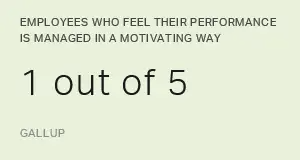
Gallup’s research has found that only one in three workers in the U.S. strongly agrees they received recognition or praise for doing good work in the past seven days. And employees who do not feel adequately recognized are twice as likely to say they’ll quit in the next year. (Gallup)
A longitudinal Gallup and Workhuman study tracking more than 3,400 employees from 2022 to 2024 found that employees who received high-quality recognition were 45% less likely to have left their job by the end of that period.
The gap between what recognition can do and what most organizations are actually doing with it is enormous. And most of the time, that gap is not a budget problem. It’s a starting problem.
Most HR leaders evaluating an appreciation initiative are not doing it for the first time. They’ve either inherited a program that isn’t working, they’ve been through a merger that scrambled everything, or they’re responding to an employee survey that flagged appreciation as a gap. In all three cases, they’re coming in with scar tissue. They’ve seen programs launch with excitement and quietly fade. They’ve watched vendors promise transformation and deliver a login page.
So they do the sensible thing. They build a requirements list. They set up demos. They loop in IT. They involve Finance. They form a steering committee.
And then they stall.
Part of this is institutional. Enterprise decisions move slowly by design. But part of it is something specific to this category: there are a lot of options, and it’s not always obvious which ones map to the actual problem you’re trying to solve.
Forrester’s research on employee experience management has found that recognition capabilities are “especially powerful” because people are far more likely to be engaged when they feel uniquely seen and valued for who they are and what they contribute. Conversely, when they don’t feel that way, they’re more likely to burn out. (Forrester)
But the same research notes that organizations get stuck in cycles of measurement without action. Annual surveys. No follow-through. Participation wanes. Another survey. The cycle repeats.
Forrester’s 2025 HCM evaluation observed a fundamental shift underway: HCM is no longer simply about HR, benefits, and payroll. It’s about creating a unified, consumer-grade experience that engages every type of worker, from the corporate office to the front line. When employees interact with recognition, they’re not comparing it to your last all-hands. They’re comparing it to the best consumer app they used this morning. The bar is high. And the distance between a spreadsheet and that bar feels, to the person running the spreadsheet, impossible to close in one project.
But it doesn’t have to be closed all at once.

Deloitte’s 2025 High-Impact Total Rewards research showed that high-maturity organizations are 3.1 times more likely to optimize return on total rewards investment, 1.5 times more likely to retain high performers, and delivering 55% higher three-year average earnings per share compared to low-maturity peers.
What those organizations have in common is not a more sophisticated vendor. They have operational intent. They’ve designed their programs rather than defaulted to them. And consistently, the most significant maturity gap occurs between levels 1 and 2 of the maturity model. Many organizations invest heavily but never cross the threshold where rewards stop being administered and start being designed.
That one insight is worth sitting with. The biggest leap isn’t from good to great. It’s from accidental to intentional.
The difference between a Level 1 and a Level 2 organization is not complexity. It’s visibility. It’s whether people can see appreciation happening. It’s whether recognition is a private transaction between a manager and an employee, or something the entire team can experience and build on. That shift requires almost nothing from a technology standpoint. What it requires is the decision to make appreciation visible.
There is a version of WorkProud that requires no payment setup, no rewards catalog configuration, no HRIS integration, and no call with our sales team. You log in. You add your logo. You invite your team. You start recognizing people.
That’s a complete program. Not a prototype. Not a demo environment. A functioning, branded recognition experience where leaders and peers can post appreciation publicly, tie it to your values, and watch the social feed build in real time. No points. No catalog. No procurement event. Just the experience itself.
And that experience is what drives everything downstream.
The organizations that have done this well didn’t start with the most complex programs. They started with the clearest intent.
When Gables Residential came to WorkProud, their recognition program was an annual awards banquet. Only 14% of associates were recognized each year, and many had no idea what they or others had done to earn it. Administration was inconsistent and cumbersome because everything was run manually.
The program wasn’t failing because of a bad tool. It was failing because recognition that happens once a year doesn’t build a culture. It builds a night out. Once they modernized the program through WorkProud, the result was more than 11,000 recognitions per year instead of 140, with 95% of associates participating. The program delivered a 10:1 ROI on the recognition piece alone and approximately 35:1 on the total enterprise-wide program, funded entirely by reallocating the budget previously spent on the annual banquet.
No new investment. No new budget line. A reallocation and a design decision.
Webster Bank’s story starts in a different place but arrives at the same lesson. After a merger brought together Sterling National Bank and Webster, two organizations with completely different approaches collided. One used an existing recognition tool with inconsistent adoption. The other ran on emails, spreadsheets, and hand-distributed gift cards. Both had good intentions. Neither had a shared culture.
They needed more than a new tool. They needed a unifier. Powered by WorkProud, Webster launched STARS: a branded, bank-wide recognition program tied to company values with a live social feed accessible across all 195 branches. Recognition activity increased 265%. Overall engagement scores improved three points year-over-year, with the recognition-specific question in their annual survey showing a five-point increase.
Recognition also played a direct role in acquisition integration. As newly acquired employees entered the organization, a shared experience replaced inconsistent manual processes and created immediate cultural belonging.
“Recognition gave us a common language right away. No matter where you came from, it was something we could all share.”
— Joyce Murray, Director of Colleague Experience, Webster Bank
That is not a feature. That’s what happens when the experience is designed rather than defaulted.
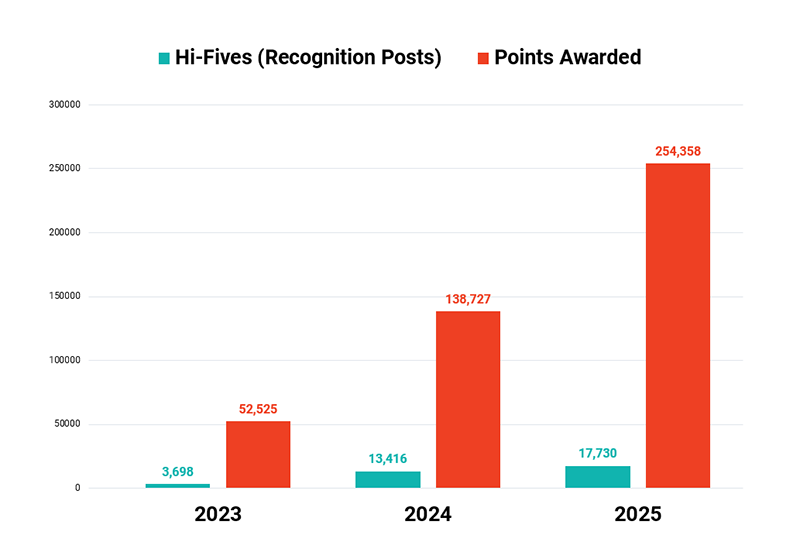
WalkMe took the same principle into a global, multi-geography workforce. When Madeline Des Jardins joined as Global Senior Director of Internal Communications and Employee Engagement in 2022, recognition lived in a Slack channel. Managers couldn’t see whether their teams were being acknowledged. There was no record. No reward. No way to measure whether any of it was working.
After evaluating vendors, she launched WalkProud in April 2024 with a deliberate design: every employee would have the power to recognize peers monthly, every recognition would be tied to a company value, and all existing awards would be consolidated into one experience. Within 18 months, 96.2% of all team members were registered. They generated more than 12,000 recognition posts. eNPS increased 130% from 2022 to 2025. Recognition favorability rose 42% and rewards favorability climbed 50%.
“For the first time in WalkMe history, every employee had the ability to reward others.”
— Madeline Des Jardins, Global Sr. Director, Internal Communications & Employee Engagement, WalkMe
That’s the domino effect at work. Not because the catalog was perfect or the integrations were flawless. Because appreciation became visible, democratic, and habitual.

“The absolute irony of expecting HR to fix the culture when the people who created it are still in the room and still in charge.”
— People & Culture Collective
It’s sharp. And it points to something real.
Culture is not an HR deliverable. It’s a leadership behavior that gets reinforced or undermined every day, at every level, in every interaction. HR can build the infrastructure. HR can design the program. HR can create the conditions. But culture moves through managers, and managers move through how they treat people.
Gallup’s research makes the mechanism explicit: recognition is both a tool for individual reward and an opportunity to reinforce the desired culture of the organization to everyone watching. When a manager recognizes someone publicly, it signals to the entire team what success looks like here.
This is exactly why visibility is non-negotiable. A private thank-you email is meaningful to the person who receives it. A public recognition post is meaningful to the person who receives it and to every person who sees it. The social signal reinforces what the organization actually values, at scale, without a training program, without a memo, without a meeting.
Gallup recommends recognition frequency of at least every seven days and notes that the most effective recognition is honest, authentic, and individualized. Their data also found that nearly one-quarter of employees say the most memorable recognition comes from a high-level leader or CEO. Senior leaders don’t need to recognize every person every day. They just need to show up in the feed consistently enough that employees believe recognition is something leadership actually cares about (not something HR administers).
“Culture is not a support system; it is the system in itself. It has to be deliberate, it has to be intentional. We need to bring it to the top, give it the same relevance and attention as strategy, growth, numbers, revenues.”
— Latha M R, HR Director, Techno Brain Group
When recognition is designed well, it reinforces values consistently, at scale, through every manager and every team, without requiring HR to chase participation. When it’s not designed at all, culture becomes whatever the loudest voices in the room model. That’s rarely the culture you’d choose.
The organizations most likely to succeed with recognition are not the ones that built the most comprehensive program from day one. They’re the ones that answered a simple question early: what do we want our people to feel?
From that answer, everything else follows.
Deloitte’s maturity model describes Level 1 as transactional and siloed. Recognition is inconsistent, technology is underutilized, and data is minimal. Level 2 is established and connected, where basic alignment emerges but recognition still lacks a unifying strategy. Most organizations reading this are somewhere between those two levels right now. The goal is not to skip to Level 4. It’s to make the first deliberate design decision that moves you from accidental to intentional.
For most organizations, that decision is simpler than they think.
Get the experience right first. Make appreciation visible. Give managers a tool that takes minutes to use, not hours to configure. Let the social feed build. Watch what happens when recognition stops being a private transaction between two people and becomes a shared cultural signal visible to everyone.
Then, when the organization’s appetite for it grows, add the catalog. Add the integrations. Add the reporting. Build toward sophisticated budget controls and analytics as the program matures. WorkProud supports that full spectrum. From a complimentary setup with no shopping experience required, through full enterprise deployment with HRIS integrations, custom catalogs, and six live analytics dashboards. You don’t have to buy all of it to start.
The mistake most organizations make is treating the starting point as a commitment to the finish line. It’s not. Starting is just starting.
Gallup’s analysis found that if a business of 10,000 employees doubled the number of people who received recognition in the past week, the organization could realize a 9% increase in productivity, a 22% decrease in safety incidents, and a 22% decrease in absenteeism, translating to nearly $92 million in gained productivity alone for an organization of that size.
Those are not soft numbers. They are not engagement survey scores. They are operational and financial outcomes tied directly to whether people feel seen for the work they do.
And the mechanism is simple. Beyond the individual receiving it, recognition sends a message to everyone else about what success looks like in this organization. It is simultaneously a personal reward and a cultural signal.
WalkMe called it democratizing rewards. Webster called it a common language. Gables called it what their people really like. The language is different, the industries are different, the scale is different. The mechanism is the same.
A manager recognizes someone in front of their peers. Someone else sees it and does the same. A new hire on day one watches it flow through the organization and understands immediately what kind of place they’ve just joined. That understanding is not taught in onboarding. It’s shown through the lived experience of the culture.
That’s the domino. And it doesn’t require a procurement event to set it in motion.
If you’re currently managing appreciation with a spreadsheet, you’re not behind. You’re at the beginning.
The beginning is a perfectly reasonable place to start.
Building community at work? It’s lonely. Especially when you’re the only one in your organization who gets it.
That’s why we’re building TEECH! This is a community for HR leaders, Total Rewards professionals, and People ops folks who are tired of theory and want real execution.
You’ll find:
We’re opening the waitlist now. Join here and be part of something built for people like you.