

There is no shortage of employee engagement tools to choose from, and most of them offer a participation dashboard or a points ledger that is created once and typically isn’t updated for months or reviewed until someone asks why turnover is up.
In contrast, an advanced employee engagement tracking tool will have:
You should be looking for those four capabilities when evaluating high-quality employee engagement tracking tools.
In this article, we’ll go over 7 employee engagement tracking tools, starting with our own, WorkProud, which we’ll carefully explain in the context of those 4 factors above.
Note: WorkProud was built to fulfill the four capabilities above. You can read about it in detail below or schedule a demo if you want to see exactly how it could help your organization track, measure, and act on engagement data.
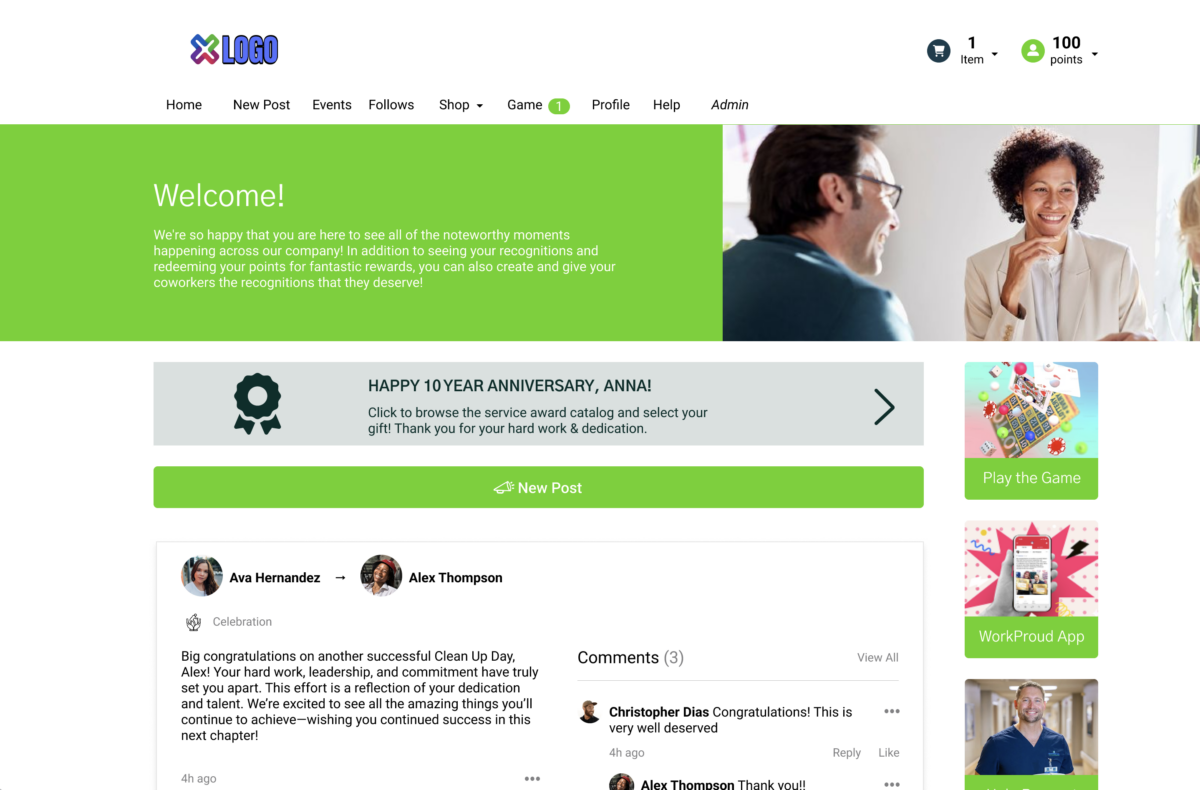
WorkProud is a unified employee engagement and recognition platform built to directly address the four tracking capabilities mentioned above:
Below, we’ll explore each one in detail.
Most employee engagement tools have some type of recognition feed or activity log. What most don’t have is the ability to tie every recognition moment back to a specific company value, behavior, or mission pillar — and then report on which values are gaining traction and which are being ignored.
WorkProud structures recognition around your company’s actual values and objectives. When a manager or peer sends a Celebration post, a Spot Award, or a Recognition post, they’re not just writing a message — they’re tagging it to a value, a mission, or a behavioral standard your organization has defined. That data accumulates over time into a picture of which values are alive in your culture and which ones are still just words on a poster.
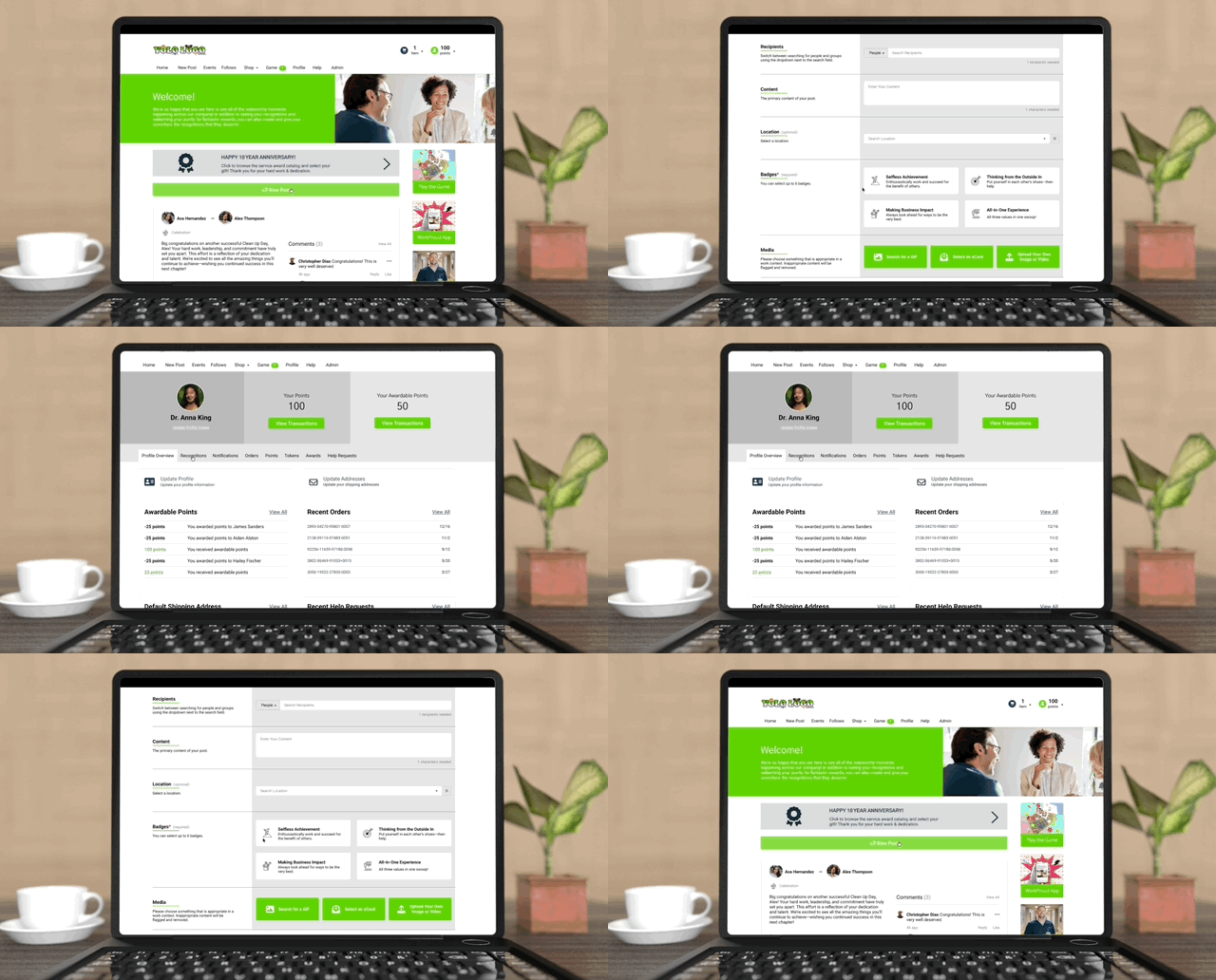
From the recognition feed, employees and managers are able to send peer-to-peer recognition, manager-to-employee awards, group recognitions, and accomplishment posts — each one categorized by post type and tied to the mission or value it reflects.
WorkProud’s platform supports multiple distinct post types — Milestones, Recognition, Accomplishment, Celebration, Announcement, Ideas/Tips/Tricks, and Launch — each of which generates its own engagement signal. Furthermore, every admin of WorkProud can customize the post types to suit their needs, wants, etc. For example, one organization dedicated an entire post type to a halloween pet contest! This matters because it lets you see not just how much recognition is happening, but what kind. Are people celebrating launches? Sharing ideas?
Recognizing safety behaviors? Each category is searchable and filterable, so you can pull a year’s worth of values-based recognition history before a performance review or QBR without digging through Slack archives. For a deeper look at which KPIs are worth tracking, see Employee Rewards and Tracking Recognition Efforts: Key Performance Indicators You Should Be Tracking.
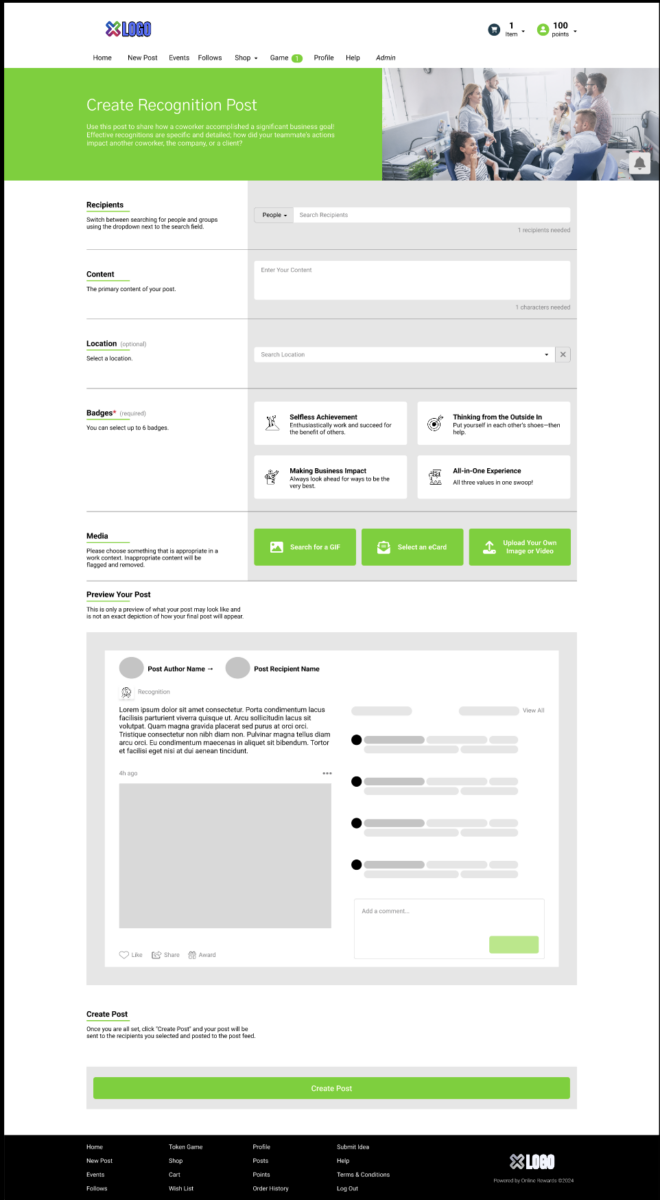
Posts can be filtered by mission category — Collaboration, High-Performance, and others configured to your organization — so HR leaders can quickly surface which teams are living specific values and which aren’t. For example, if your safety culture initiative is a priority but “Safety” recognitions are flat for three consecutive months in one facility, that’s a data point worth acting on before it becomes a turnover problem.
Every recognition moment — received and created — is logged in each employee’s Award History. This gives HR leaders and managers a complete, timestamped record of an individual’s recognition activity: who recognized them, for what behavior, tied to which value, and when. Before a performance conversation, a promotion discussion, or an exit interview, that history is already there. You don’t have to reconstruct it from memory or a manager’s notes.
In most engagement tools, manager adoption is tracked as a binary: did they log in or not? That tells you almost nothing about whether recognition is actually happening at the team level or whether certain managers are quietly disengaged from the program.
WorkProud gives HR leaders and program administrators visibility into recognition frequency and participation by manager, team, department, and location — in real time, not in a quarterly report. When you can see that one regional manager has sent zero recognitions in 60 days while their team’s participation rate is dropping, you have something actionable. When you can see that a newly promoted manager is recognizing at 3x the rate of their peers, you have a coaching story worth sharing.
WorkProud tracks participation across the following dimensions: individual employees, managers, departments, locations, business units, and program types. Gables Residential — a 1,200-associate real estate company — went from 140 recognitions per year to over 11,000 annual recognitions with 95% associate participation after consolidating onto WorkProud. That shift didn’t happen because employees suddenly became more engaged. It happened because the platform made participation visible, which made accountability possible.
Employees who stop receiving recognition — or whose managers stop sending it — are often the ones who leave. WorkProud’s engagement data lets you track recognition frequency at the individual and team level, so you can identify the quiet disengagement that precedes a resignation before it becomes a replacement cost. Jersey City Medical Center, a 2,500-employee regional healthcare system, used WorkProud to reduce turnover by 18% within 12 months, saving approximately $2.1 million in recruitment and training costs. The mechanism wasn’t a new policy — it was visibility into where recognition was happening and where it wasn’t. You can read more about how recognition reduces healthcare turnover in Reducing Turnover With Employee Recognition: Strategies for Healthcare Organizations.
Tracking engagement only works if the platform reaches every employee. WorkProud’s native iOS and Android apps, combined with a mobile-responsive web experience, mean that recognition activity is captured whether an employee is at a desk, on a hospital floor, or working a warehouse shift. Engagement gaps that appear in the data often reflect access gaps in the tool — WorkProud closes that gap by meeting employees where they are.
Most organizations don’t have one engagement program — they have several. Peer recognition lives in one tool. Service milestones get tracked in a spreadsheet. Spot awards are processed through a separate vendor. Referral bonuses are handled by payroll. Wellness incentives are managed by a third-party app. When your CFO asks what you got for your people investment last year, you’re pulling data from five different places and hoping the numbers add up.
WorkProud consolidates recognition, milestone events, spot awards, employee referrals, wellness programs, innovation submissions, and custom incentive programs under a single platform. Every program generates data in the same system, which means your engagement history is unified — one record, one dashboard, one source of truth.
From onboarding recognition to 10-year service milestones, WorkProud tracks every award event in a single, searchable history. HR leaders can view the complete history of received and created awards for any employee — filtered by program type, time period, value category, or award amount. This is the data that makes performance conversations credible and retention conversations proactive.
WorkProud also tracks point account balances and redemption activity alongside recognition data. This matters because reward redemption rates are a leading indicator of program health — employees who never redeem points are often employees who don’t feel the program is meaningful. When redemption drops in a specific department, that’s a signal worth investigating before it shows up in an engagement survey six months later.
Beyond peer recognition, WorkProud supports custom incentive programs tied to sales performance, attendance, safety metrics, and other KPIs — all tracked within the same platform. For example, if a manufacturing client runs a safety incentive program alongside a peer recognition program, both data streams are visible in the same reporting environment. That makes it possible to see whether safety recognition and safety incident rates are moving in the same direction — and to make the case for the program with data, not anecdotes.
In most engagement tools, reporting shows you what happened: how many posts were sent, how many points were issued, how many employees logged in. That’s activity data. What your CFO wants — and what a board-ready business case requires — is outcome data: what did the engagement program actually produce in terms of retention, productivity, and cost savings?
WorkProud’s Tableau-powered reporting dashboards are built to bridge that gap. Rather than showing you a points ledger, they show you the relationship between recognition activity and the business outcomes that matter: turnover rates by department, engagement trends over time, program participation correlated with retention, and ROI calculations based on your actual replacement cost assumptions. For a full walkthrough of how to calculate and present engagement ROI, see The ROI of Employee Engagement: How to Measure Success.
WorkProud’s reporting is filterable by department, location, manager, business unit, program type, time period, and value category. This makes it possible to answer specific questions — not just “how is the program doing?” but “which locations have the lowest recognition frequency, and how does that correlate with their turnover rate?” or “which managers are driving the highest participation, and what are they doing differently?”
For example, if a VP of HR sees that recognition frequency in one region dropped 40% over the last quarter and then notices that voluntary turnover in that region is trending up, they can make a data-driven decision to intervene — with a manager coaching conversation, a program refresh, or a targeted communications campaign — before the turnover becomes a budget problem.
WorkProud’s dedicated HR and Certified Recognition Professionals conduct quarterly business reviews with each client, using the platform’s reporting data to build the ROI narrative. Gables Residential documented a 10:1 ROI on recognition alone and a 35:1 ROI across their full program — not as an estimate, but as a calculated figure based on actual program costs, recognition volume, and measurable engagement outcomes. That’s the kind of number that survives a budget review. Read the full story in How Gables Residential Delivers ROI from Employee Recognition.
WorkProud integrates with Workday, SAP, and other major HRIS systems via SSO, which means recognition data can be viewed alongside workforce data — headcount, tenure, department structure, and turnover history. When your engagement data and your workforce data live in the same reporting environment, the connection between recognition behavior and retention outcomes becomes visible in a way that a standalone recognition tool can never produce.
If you’re evaluating platforms to get real visibility into where engagement is strong, where it’s breaking down, and what your program is actually producing — talk to a WorkProud expert. No pitch deck. Just a conversation about what you’re trying to measure and what decisions you need the data to support.
Workhuman is an enterprise social recognition platform with approximately 7 million users across 180+ countries. It’s built around peer-to-peer recognition and positions itself on 25 years of recognition data and AI-powered analytics through its Workhuman iQ capability. The platform includes sentiment analysis, real-time recognition feeds, and integration with Workday, Slack, and Microsoft Teams.
Where it works well: large enterprises that want a social recognition layer with AI-driven insights and a strong thought leadership narrative. Where it gets complicated: customers consistently report complex initial setup, difficulty ensuring consistent user adoption after launch, and frustration with point thresholds that make rewards feel out of reach. The vendor relationship tends to be software-first — the platform is handed over and adoption becomes the client’s problem to solve.
Awardco is a recognition platform built around a large reward catalog — including zero-markup access to Amazon Business — and serves approximately 3,000 organizations across 163 countries. It recently launched Awardco Engage™ to add employee listening and sentiment data alongside recognition activity.
Where it works well: organizations that prioritize catalog breadth and transparent reward economics. Where it gets complicated: G2 reviewers frequently cite interface complexity, difficulty filtering and sorting reward options, and support issues that surface after implementation. The platform’s strength is in reward delivery; the analytics and managed service depth that enterprise HR leaders need to build a CFO-ready ROI narrative is still developing.
O.C. Tanner’s Culture Cloud platform serves 1,100 multinational clients with a heritage in service awards, milestone recognition, and ceremonial awards. The platform has expanded into digital recognition and launched a Culture Intelligence suite in 2024 with AI-enabled coaching features.
Where it works well: large enterprises with significant long-tenured employee populations for whom milestone recognition and symbolic awards carry cultural weight. Where it gets complicated: implementation timelines average four months, ROI realization often takes 12+ months, and customers note that the analytics positioning emphasizes culture metrics rather than business outcome quantification. For a VP of HR who needs to defend the program budget in a CFO conversation, that gap matters.
Bonusly is a peer-to-peer recognition tool built for distributed and hybrid teams, with strong Slack and Microsoft Teams integration and transparent per-user pricing starting around $2–3/user/month. It’s clean, fast to implement, and easy to adopt.
Where it works well: mid-market teams that want lightweight peer recognition without enterprise complexity. Where it breaks: Bonusly has no managed service model, limited governance tools for complex approval workflows, and analytics that don’t extend to business outcome measurement. When your program needs governed budgets, multi-program consolidation, and someone accountable for adoption beyond launch day — the self-service model runs out of runway.
Achievers is an enterprise recognition platform serving mid-market and large organizations with a points-driven recognition architecture, global rewards marketplace, and employee voice analytics. It emphasizes recognition frequency and has expanded into engagement scoring and sentiment tracking.
Where it works well: organizations that want a structured, standardized recognition program with clear adoption metrics. Where it gets complicated: the platform’s customization flexibility is more limited than enterprise buyers often expect, and the implementation model — while faster than some competitors — still leaves adoption accountability primarily with the client’s internal team.
Vantage Circle is a multi-module engagement platform combining recognition, wellness, perks, and pulse surveys, with a strong presence in Asia-Pacific markets. It serves medium to large enterprises with a cost-competitive pricing model and broad catalog coverage across 100+ countries.
Where it works well: global organizations looking for a broad engagement platform at a lower price point, particularly in growth markets. Where it gets complicated: the platform is less customizable per client than enterprise-specific programs require, and the managed service depth — dedicated HR professionals co-owning program outcomes — isn’t part of the model.
Most engagement tools will show you that recognition is happening. WorkProud shows you whether it’s working — which teams are being left behind, which values are gaining traction, which managers are building culture and which ones aren’t, and what the program is producing in terms of retention and ROI.
WorkProud was specifically built to turn engagement tracking into a management tool, not just a reporting exercise. With nearly two decades in the market, a 96% client retention rate, and 12 million active users across 450+ programs, it’s the platform enterprises turn to when they need data that survives a budget review.
If you’d like to see how it works for your organization, schedule a demo or read how four companies used WorkProud to measurably reduce turnover in Best Employee Retention Software: How Employee Recognition Helped 4 Companies Retain Employees.
An icon of style from Hollywood to hip-hop, the Wayfarer never stands still. Forever embraced by the next generation of culture makers, now its journey continues with AI-enhanced wearable tech. Ray-Ban Meta Wayfarer enables you to live in the moment and share how you see the world. Listen, call, capture and livestream features are seamlessly integrated within the classic frame. Eye size: 50; Frame: Matte Black; Lens: Clear/Graphite Green Transitions; Lens Material: Standard Plastic
Color: Matte Black/Clear-Graphite Green Transitions
A
Afghanistan
Albania
Algeria
Andorra
Angola
Antigua & Deps
Argentina
Armenia
Australia
Austria
Azerbaijan
B
Bahamas
Bahrain
Bangladesh
Barbados
Belarus
Belgium
Belize
Benin
Bhutan
Bolivia
Bosnia Herzegovina
Botswana
Brazil
Brunei
Bulgaria
Burkina
Burundi
C
Cambodia
Cameroon
Canada
Cape Verde
Central African Rep
Chad
Chile
China
Colombia
Comoros
Congo
Congo {Democratic Rep}
Costa Rica
Croatia
Cuba
Cyprus
Czech Republic
Denmark
D
Djibouti
Dominica
Dominican Republic
E
East Timor
Ecuador
Egypt
El Salvador
Equatorial Guinea
Eritrea
Estonia
Ethiopia
F
Fiji
Finland
France
G
Gabon
Gambia
Georgia
Germany
Ghana
Greece
Grenada
Guatemala
Guinea
Guinea-Bissau
Guyana
H
Haiti
Honduras
Hungary
I
Iceland
India
Indonesia
Iran
Iraq
Ireland {Republic}
Israel
Italy
Ivory Coast
J
Jamaica
Japan
Jordan
K
Kazakhstan
Kenya
Kiribati
Korea North
Korea South
Kosovo
Kuwait
Kyrgyzstan
L
Laos
Latvia
Lebanon
Lesotho
Liberia
Libya
Liechtenstein
Lithuania
Luxembourg
M
Macedonia
Madagascar
Malawi
Malaysia
Maldives
Mali
Malta
Marshall Islands
Mauritania
Mauritius
Mexico
Micronesia
Moldova
Monaco
Mongolia
Montenegro
Morocco
Mozambique
Myanmar
M
Namibia
Nauru
Nepal
Netherlands
New Zealand
Nicaragua
Niger
Nigeria
Norway
O
Oman
P
Pakistan
Palau
Panama
Papua New Guinea
Paraguay
Peru
Philippines
Poland
Portugal
Q
Qatar
R
Romania
Russian Federation
Rwanda
S
St Kitts & Nevis
St Lucia
Saint Vincent & the Grenadines
Samoa
San Marino
Sao Tome & Principe
Saudi Arabia
Senegal
Serbia
Seychelles
Sierra Leone
Singapore
Slovakia
Slovenia
Solomon Islands
Somalia
South Africa
South Sudan
Spain
Sri Lanka
Sudan
Suriname
Swaziland
Sweden
Switzerland
Syria
T
Taiwan
Tajikistan
Tanzania
Thailand
Togo
Tonga
Trinidad & Tobago
Tunisia
Turkey
Turkmenistan
Tuvalu
U
Uganda
Ukraine
United Arab Emirates
United Kingdom
Uruguay
Uzbekistan
V
Vanuatu
Vatican City
Venezuela
Vietnam
Y
Yemen
Z
Zambia
Zimbabwe
Here you will find insights curated for leadership seeking in-depth industry knowledge. Explore comprehensive studies, helpful guides, and expert white papers.
*By selecting “VIEW RESOURCES,” you agree to WorkProud’s Privacy Policy. You may unsubscribe from our emails at any time. Please note when unsubscribing: it may take up to 10 business days for your request to take effect.